
Ask for help.
… when you really need it.
See the post “Shift your perspective.” for the first in this series exploring my atomic (in the sense of a thought or idea being reduced to its most basic essence) sticky notes. My hope is that these concepts are universal and applicable across multiple domains, including work, life, and parenting.
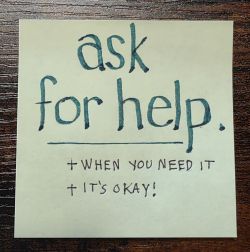
Next up is “Ask for help.”:

Pretty straight-forward, this one, but important to highlight, especially in the context of parenting.
At the detail level, we have:
- When you need it
- It’s okay!
If you’re someone for whom asking for help does not come naturally, this can be challenging, if not intimidating. It’s a matter of degree, isn’t it? We all know people that will ask for help at the drop of a hat, regardless of its impact on anyone else, and regardless of the level of effort required to help themselves. We don’t want to be that person. It’s natural.
Especially when it comes to parenting. We can be very sensitive to the external perception of ourselves as parents and our fitness for the role. “What kind of parent am I if I can’t figure this out?”, we might ask ourselves from time to time. Or more pertinently perhaps, “What will they think of me and my parenting skills, or lack thereof?”. So many obstacles to asking for help.
But when you really need it, when you really, REALLY need it, please find someone trusted and reach out to them for help or advice.
Someone might be a spouse or parenting partner (though if they have a markedly different parenting style you might not *want* to – consider it anyway) or a relative or a friend or a community forum of some kind.
Help might be picking up your kids from practice, or making a meal for your family from time to time.
Advice might be how to deal with a teenager that is acting rebelliously.
If it helps, apply some measure to your amount of need, but if you do, please ask for help when you need it… and I think you know when you do.
And you can “ask” for help by referring to a trusted resource, related to whatever current problem you’re needing to solve.
How to ask for help
From Debbie Sorenson at Psyche, here is a list of things you can do and consider as you prepare to ask for help.
First, check for assumptions you might have about asking for help:
- Negative associations – you may not want to be thought of as someone that can’t help themselves, for example.
- Self-criticism – you might feel that asking for help would make you seem weak or helpless.
- Concerns about how you will be perceived – you might worry what others might think of you if you ask for help.
- Overestimating the likelihood of rejection – because why would anyone help?
Decide to ask for help. As you do, you may want to consider the bigger picture – what is most important in this moment? And long term, will asking for help further or hinder your goals for yourself or for others, especially your child?
Then decide who to ask. Consider who is in the best position to help you. In some cases that might be a professional of some kind, especially if you’re really struggling emotionally. I know that’s a barrier for some. Try to follow the process with them. But consider relationship dynamics with your friends, family, and colleagues, and try to find someone that you can trust to respond compassionately.
Debbie reminds us here to be compassionate with ourselves first, and really explore the emotions that might underlie any continued reluctance. Do you feel guilty or ashamed about asking for help? Are you afraid you’ll be rejected? Notice those feelings and acknowledge them, but try to see if you can practice watching them as an observer.
Use assertive communication skills (“I’ve been struggling with ____, would you be willing to help?“) and be clear about what it is that you need. Other examples Debbie suggests are:
“Could you help me out by ____?”
“I was wondering if you could do me a favor and ____.”
“Could you please ____ for me next Tuesday?“
If someone agrees to help, accept it, and share your gratitude. If they don’t, it doesn’t mean you won’t be able to get the help you need… it’s just time to consider other options.
Resources
Here is a list of Positive Discipline parenting resources. It’s separated into products, articles, and classes. If you click on the button for Parenting Articles, you will be taken to a list of foundational Positive Discipline concepts to explore. It’s a welcoming and encouraging philosophy and tool kit, and I hope you’ll explore it further.
My personal favorite Positive Discipline book is “Positive Discipline A-Z” – it’s chock full of solutions by parenting challenge and has been a huge source of self-help for me almost daily.
Here also is a link to the resources page on this site.
And if you need more details about how to ask for help, please read Debbie’s full article. In the links she shares at the end is a particularly wonderful and engaging TED talk from Heidi Grant on the subject.
Please reach out for help when you need it. In whatever way you’re most comfortable with. But no one can do this alone.

Contact us
Please share anything that comes to mind, whether it’s feedback on the website or its layout, suggestions about the content, or anything at all that comes from your perspective and we will get back to you as soon as we can.
Any messages are considered confidential (the message is sent to tim@sharingperspectives.com) and will not be shared under any circumstances.


Discover more from sharing perspectives
Subscribe to get the latest posts sent to your email.
 sharing perspectives