
Shift your perspective.
An experimental post

So the blog is called “Sharing Perspectives”, and there’s a reason.
I propose that the most urgent and vital thing we can learn as sentient beings is to think and feel from another’s perspective.
Perspective is an interesting word to me, full of meaning and implications and possibilities, but the point I’d like to make is that, with enough practice, we can truly imagine ourselves in someone else’s place, either mentally or emotionally, which allows us to cross a crucial gap from sympathy (or even apathy) to empathy.
How is empathy different?
“Empathy is our ability to understand how someone feels while sympathy is our relief in not having the same problems.”
That comes from a group called Psychiatric Medical Care, who explore the differences in more depth in an article posted here. But what I’d like to focus on is the idea that sympathy causes separation, while empathy fosters connection.

From the article:
Brene Brown describes sympathy as a way to stay out of touch with our own emotions and make our connections transactional. Sympathy puts the person struggling in a place of judgment more than understanding. A person seeks to make sense of a situation or look at it from their own perspective.
Further:
Empathy is defined as “the feeling that you understand and share another person’s experiences and emotions” or “the ability to share someone else’s feelings.” It is looking at things from another person’s perspective and attempting to understand why they feel the way they do.
Seeing from another’s perspective makes us more empathetic – not just towards one person, but just a little towards people in general – which fosters connection and understanding.
How can this help?
So what to do with this knowledge? How can we learn to see from another’s perspective? How can we teach our children to?
While some people naturally possess empathy, it’s also something you can learn, develop, and even teach.
To quote one of my mentors:
“The life skill of being able to look at things from more than just your point of view can be taught by simple modeling and observations.” – Dr. Jody McVittie
She uses the example of a child wanting a toy that another child has. The first child unconsciously frames their problem as “I want that toy.” The obvious solution to which, of course, is to take it.
Saying to the child “It looks like you both want that toy” challenges them to re-frame their problem as “we both want that toy”… and suddenly other potential solutions present themselves.
Watch their face as understanding dawns… they want the toy, the other child also wants the toy, and the wheels turn to generate a solution to the newly framed problem.
What if they took turns? What if they played with the toy together?
What if, instead of feeling a need to take another child’s toy away, the first child decided on their own that their solution would be to share?
What would they learn from the situation? And what did they just practice?
Can you imagine if everyone in the world could easily adopt any and every other person’s perspective?
Could there still be violence and hunger, destitution and excess? Wouldn’t this empathy and connection and compassion and understanding foster horizontal relationships between everyone rather than hierarchies and classes?
If we scale down our ambitions just a bit – only for now – we can practice seeing and teach seeing from other perspectives as a way to create, strengthen, and deepen our interpersonal relationships – including those we have with our children.
Especially with our children.
… and now for the experimental part!
So I have kind of a thing with sticky notes. There’s something interesting to me about the implications inherent in the limited format, the portability, and the physicality as a space to keep track of things.
I’ve been using Personal Kanban, which uses sticky notes to move “things to do” through your own personal value stream, for several years now as a way to visualize my work and life tasks. At some point I started using sticky notes to capture various reminders and thoughts and musings as well, and eventually my house was pretty well pasted with them.
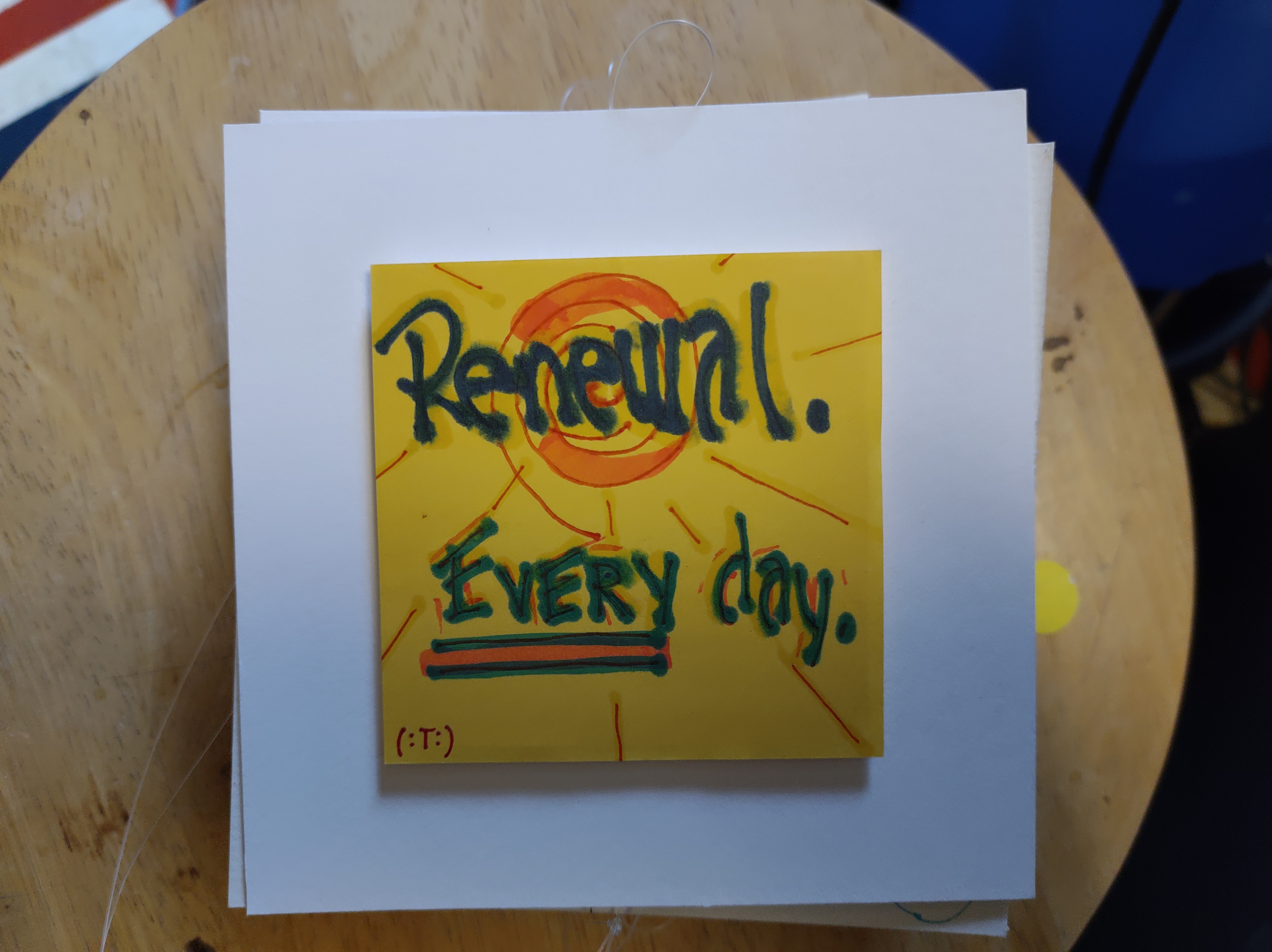
I even started to create artwork using Post-It notes and Sharpie pens. I am deadly serious about that – I participated in an art show at a local gallery in Seattle.
A theme emerges
A theme started to emerge, but I wasn’t sure what it was, or what to call it… some of the notes started feeling more significant than others. Reminders to myself, from myself, of lessons I’ve learned here and there. Ideas reduced to an atomic form. These started to claim their own space on the wall of my home office.
They were inspired in part, I think, by Dr. Rick Hanson‘s work in his book Just One Thing: Developing a Buddha Brain One Simple Practice at a Time, in which he encourages us to explore simple practices, grounded in brain science, positive psychology, and contemplative training, for just a few moments every day.
In the beginning there were maybe 6 or 8 cards.
Currently there are 24.
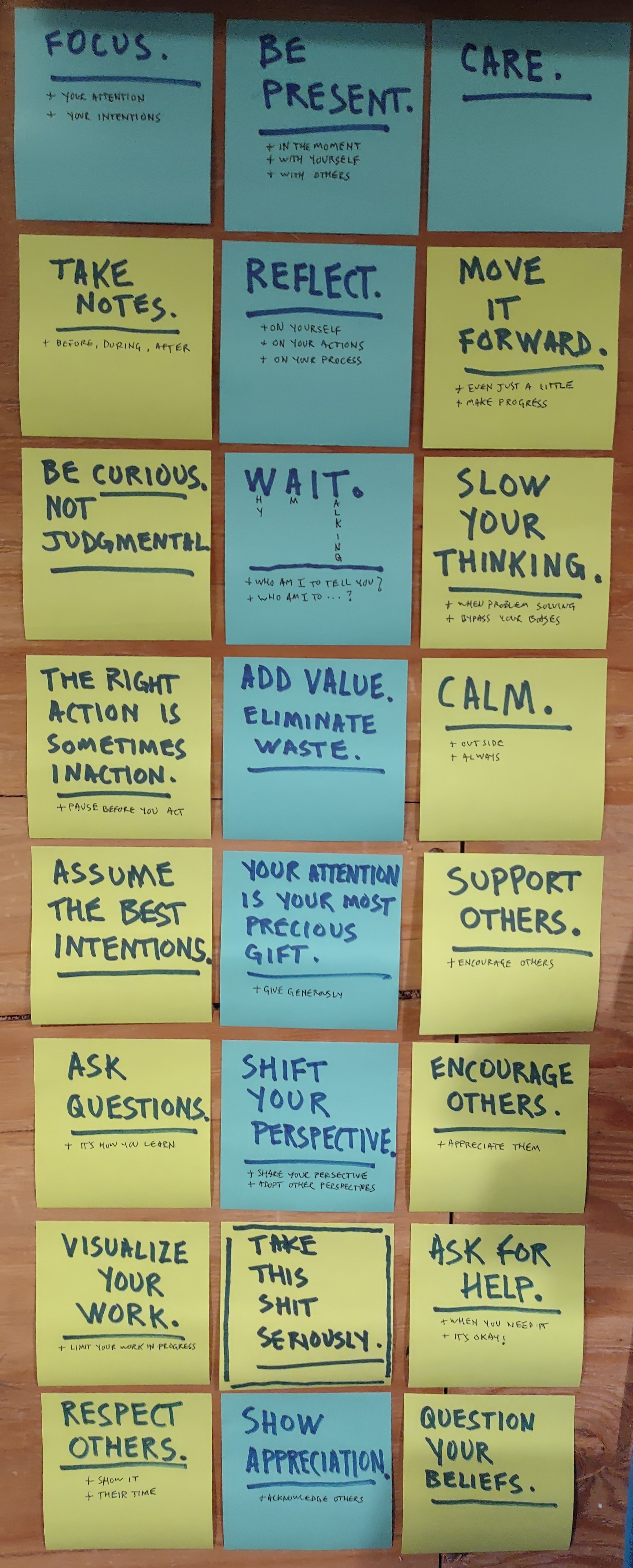
UPDATE: November 24, 2024 – I’m down to 15 cards, that each have a published article behind them. This is what they look like now:

I still don’t know what to call them… originally I thought of them as goals and thoughts to keep in mind while working. Then I wondered if they were some kind of values list, but that didn’t seem right either. I’m currently thinking of them collectively as “Guidance”, because it occurred to me that all of the best wisdom and advice I could possibly give my son was there – this is no longer a work list, it is a life list.
Shift your perspective.
I’d like to start exploring these thoughts and what’s behind them in a series of posts. Since the title of this post is “Shift your perspective.”, that’s the one we’ll zoom in on a bit.
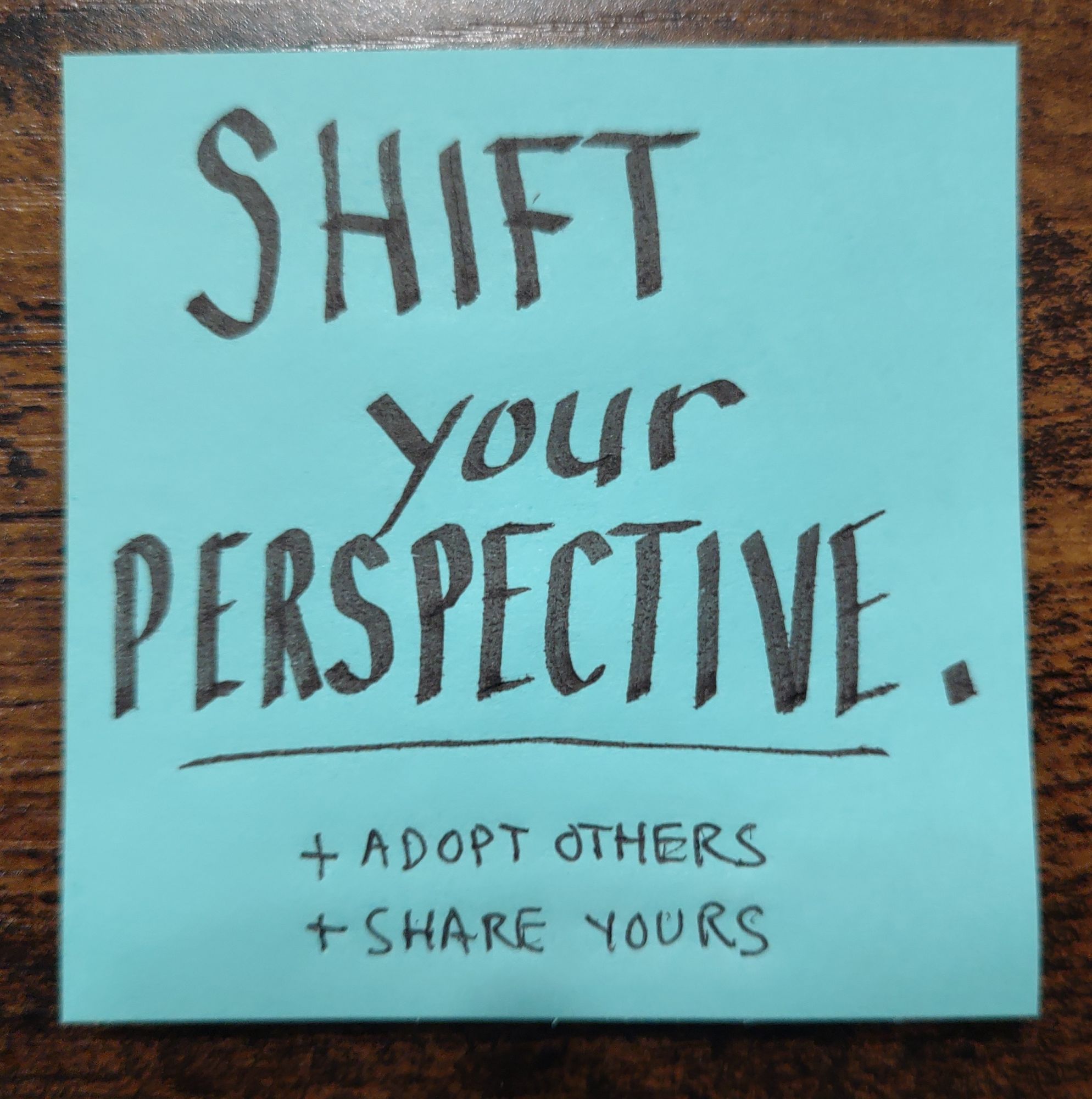
Each note title may have additional detail below it, usually extensions to or clarifications of the title. In this case, the detail level includes:
- Adopt others
- Share yours
“Adopt others” is fairly well covered above, so let’s finish with a quick look at “Share yours“.
As it turns out the inverse of the above is also true – not only can you strengthen your connections by adopting other perspectives, you can help others strengthen their connections with you by sharing your own perspective.
Sharing your perspective allows others to have a better understanding of where you’re coming from and takes some of the mystery out of interpersonal relationships – and hopefully will encourage others to do the same in return.
What’s your perspective?
Contact us
Please share anything that comes to mind, whether it’s feedback on the website or its layout, suggestions about the content, or anything at all that comes from your perspective and we will get back to you as soon as we can.
Any messages are considered confidential (the message is sent to tim@sharingperspectives.com) and will not be shared under any circumstances.


Discover more from sharing perspectives
Subscribe to get the latest posts sent to your email.
 sharing perspectives
Trackbacks & Pingbacks