
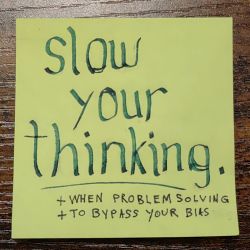
Slow your thinking.
“We can be blind to the obvious, and we are also blind to our blindness.” – Daniel Kahneman
Daniel Kahneman (along with his partner, Amos Tversky) did groundbreaking (and in fact Nobel Prize-winning) work towards understanding (and even defining) what he called “behavioral heuristics” and “cognitive biases”.
A heuristic is simply a mental shortcut that allows your brain to avoid doing actual work. One famous example is the availability heuristic:
‘The availability heuristic is a mental shortcut that occurs when people make judgments about the probability of events on the basis of how easy it is to think of examples. The availability heuristic operates on the notion that, “if you can think of it, it must be important”‘. – Wikipedia
A cognitive bias is a recurring error in thinking that applies itself even if you are aware that you have it. According to Joe Hitchcock at Inside BE:
“Cognitive biases influence the way we perceive and interpret information. They can cause us to make decisions that aren’t based on facts and behave in ways that don’t follow logic.”
An example of a cognitive bias is the framing effect – people react differently to something depending on how it is presented to them:
“While doing your groceries, you see two different beef products. Both cost and weigh exactly the same. One is labeled “80% lean” and the other “20% fat.”
Comparing the two, you feel that 20% fat sounds like an unhealthy option, so you choose the 80% lean option. In reality, there is no difference between the two products, but one sounds more appealing than the other due to the framing effect.” – Kassiani Nikolpoulou
Kahneman explores heuristics and cognitive bias in great detail in his book, “Thinking, Fast and Slow“. He also posits a model of human cognition that consists of two disparate “systems”, as a shorthand for the details of the various neurological components that they consist of.
System 1 is fast. Very fast. And instinctive. That often has its advantages.
System 2 is slow. It costs more energy, but delivers deeper, more logical results.
System 1 is kind of the default pilot as we go about our day, and whenever we put our thinking caps on, we can access System 2. Which is fine.
Except…
System 1 likes shortcuts, so heuristics and biases are its bread and butter. It does not under any circumstances care to engage System 2 if it can at all help it. When we talk about having biases in general towards something or away from something, these biases are intrinsic in our wiring, so the challenge is to:
- Be aware of System 1 and the decisions it is making on your behalf.
- Find a way to short circuit System 1 and engage System 2 when it really matters.
Let’s pause for a moment and look at our card:

To slow your thinking is to consciously and purposefully engage System 2.
When problem solving – at work, with a partner, with your child – it’s helpful to slow your thinking to make sure that you are addressing the right problem and that you don’t approach it with any built-in biases.
Once we’re aware of our biases, can we change them? Not this kind. Not even if you know about it. This kind of bias is part of you.
But… with attention and intention you can work to bypass your bias.
Slowing your thinking can help.
But remember that engaging System 2 is effortful and takes energy, so it’s important to take care of yourself and rest and relax when you can.
Have you had any luck trying to slow your thinking, maybe at a time when it really mattered? Let us know how it went in the comments!

Discover more from sharing perspectives
Subscribe to get the latest posts sent to your email.
 sharing perspectives
Trackbacks & Pingbacks