
Mistaken Goals – Update and Interventions
“The central motivation of all humans is to belong and be accepted by others.” – Rudolf Dreikurs (1897-1972)
Update
Its been a while since I checked in with the Positive Discipline source materials, and I recently found what looked to be an updated version of the Mistaken Goals Chart.
You can find more details about the chart here in my original post, but the new chart is copied below:
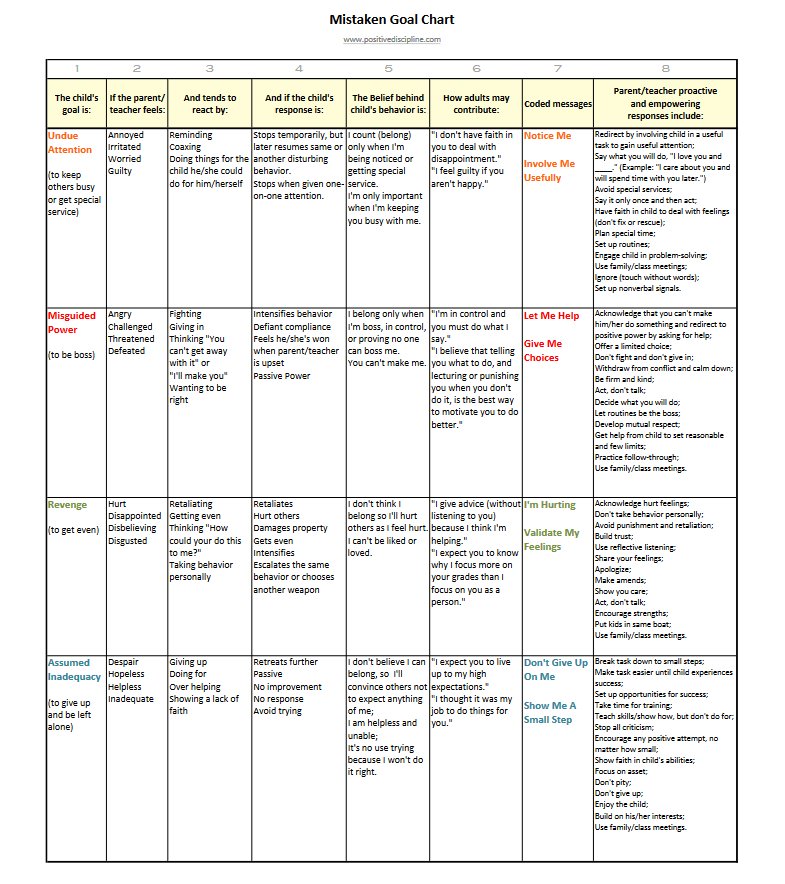
You might be thinking “Whoa… that’s a lot.” It kind of is… until you get a little practice with it.
Think of the chart as a magic decoder ring for your child’s behavior. We’ll walk through it with an example below.
I’m still in the process of comparing the updated version with the original version, but I do like the way they used colors to highlight the child’s mistaken goal and their hidden message to you, which is what you can choose to respond to rather than their outward display using the interventions in column 8.
So as a reminder and expansion, the chart looks like a lot – how do you use it? I couldn’t find a better explanation than Dr. Jane Nelson’s own:
“When children are misbehaving, they are speaking to adults in code. Learn how to break the code by following these steps:
1) Choose a behavior challenge.
2) Identify the feelings you have and how you react.
3) Identify the child’s reaction when you tell him or her to stop.
4) Use the Mistaken Goal chart to identify what belief may be behind your child’s behavior.
5) Try suggestions in the last column of the chart to encourage behavior change.”
If you’re still scratching your head (and you would not be alone!), please take a moment to jump over to learn more at the Positive Discipline site.
Parenting Interventions
I’d like to take some time here to focus in on the Chart of Parenting Interventions by Mistaken Goal that Dr. Jody McVittie and Mary Hughes adapted from Jane Nelson’s work, and I’d like to challenge you to look at it from the perspective of interpersonal relations in general, not just between parents and children – I’ve applied this at some level to my relationships with my wife, my colleagues, and my friends.
This chart is meant to be used in conjunction with the Mistaken Goals Chart to identify in detail more specific things you can try in response to your child’s coded message as interventions in any conflicts resulting from a child’s behavior.
The Mistaken Goals chart helps you see the situation from your child’s perspective – the Interventions Chart further helps you figure out what to do about it.
Please do follow the link to print out the full chart, but I thought I’d zoom in on Revenge here:

Let’s imagine a scenario in which you and your child are arguing.
Your child says something hurtful and you want to react by hurting back, but after pausing by walking away to another room and reviewing the Mistaken Goals Chart you can imagine that your child is really trying to tell you that they’re the ones that are hurting, though they may not be consciously aware of how or why.
So you’ve followed the Mistaken Goals chart based on your feelings in the second column, and determined that your child’s mistaken goal in the first column is Revenge. How can the Interventions chart help?
- Look in the middle column for ideas. The first response is to “Acknowledge the needs of the child and the needs of the situation.” Sounds great… how?
- Look at the right hand column for specifics. You scan the list next to “Acknowledge the needs...”. The first intervention is to acknowledge the child’s hurt feelings.
You might say something like “It seems like you feel _____.” Observationally, but questioningly – the child will let you know if you guessed wrong, and either way you have one more piece of information that you might not have had before.
Sometimes the best action is inaction.
For example, other potential interventions are to “Avoid feeling hurt yourself or taking it personally” and “Avoid punishment and retaliation“, which can escalate the situation. Sometimes you can just walk away from a situation until both parties have had time to cool down.
In our scenario you decide to acknowledge your child’s feelings, so once you’ve both had your cooling down periods you seek out your child and do so. You also decide to use reflective listening while the two of you talk it out.
Okay, everything is great in the world again, you’ve navigated that crisis. But what if you’d prefer to avoid similar situations in the future? Is there anything you can do to prevent them?
Why yes there is!
Helpfully included for each mistaken goal is a list of prevention tools. Under Revenge, they include things like building trust, using reflective listening, and teaching your child language for emotions, which believe it or not they may not have – I know my own son does not.
I’ll try to focus in on other mistaken goals in other posts, because I think this combination of Mistaken Goals and Intervention Charts has become the most helpful resource I’ve used as a parent.
If you’d like to explore further, take a look at this Mistaken Goal Detective Worksheet, which will walk you through using the charts from a different perspective.
What’s interesting to me is the many interactions with other adults I’ve had – at home, in the workplace, in life – that this chart has proved at least partially helpful in navigating. Is there an age when Mistaken Goals stop applying?
I’d submit that there might not be… after all, all humans need to belong and feel accepted. I know that Rudolf Dreikurs focused his research on children, but I can’t find any similar research related to adults or even much older children.
Have you tried to use these charts in real life? How did it go? Let us know!

Discover more from sharing perspectives
Subscribe to get the latest posts sent to your email.
Trackbacks & Pingbacks