
Be present.
“The moment is not found by seeking it, but by ceasing to escape from it.” – James Pierce
I was helping my son do homework the other day. He has a number of challenges to such an endeavor, and it’s often helpful for someone to sit with him while he works. Partly to be available to answer questions that come up, but partly I think just as moral support.
He was working on his laptop, and even sitting next to him I had trouble seeing what was on the screen. But he was reading through the lesson portion of a study unit.
And my attention wandered. First to the work that I could be getting done instead of sitting quietly in a chair. Then, inevitably, to my phone.
After he asked a question and I needed for him to go back to everything he just read so I could understand the context, I realized that I hadn’t really been present with him in that moment. Not to the extent that I could have been. Not to the extent that I should have been.
Here’s our card:
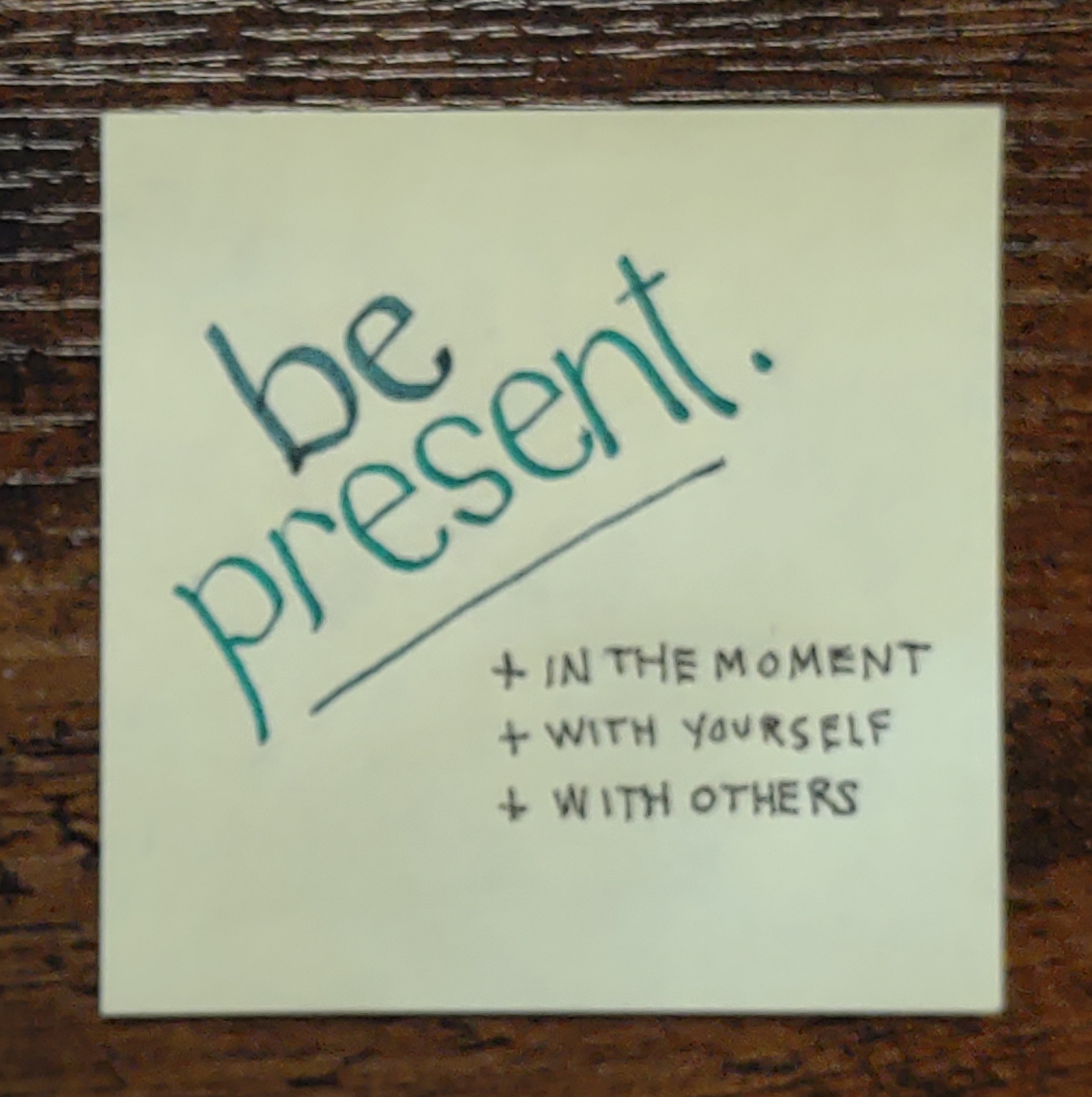
What does “be present” mean?
One simple way to look at it is: You are present when your mind is where your body is NOW.
Awareness of and presence with what’s happening in the current moment is the key to mindfulness, which simply describes the ability to sustain awareness in the present moment, without judgment. So when you’re present, you’re being mindful. And when you’re mindful, you’re being present!
It really is just that simple.
How to do it?
Here are a few ideas:
- Use your senses for observation. There’s an exercise that is used by many to help cope with anxiety known as the 5-4-3-2-1 grounding technique. The goal of this exercise is to ground yourself in the present moment.
It works something like this:
- Find five things you can see. Just mentally name 5 things you can see in the present moment – hand, book, table, cat, light.
- Find four things you can touch. Notice touch sensations in your body without even moving – the feel of your pants on your legs, the pressure of your bottom in your seat, the coolness or warmth of the air. If you want to, touch something with your fingers, maybe something that you could see.
- Find three things you can hear. Just listen, and report to yourself what you hear – voices, the wind in the trees, the hum of an air conditioner.
- Find two things you can smell. You might be surprised that you can smell in the present moment. Does the air smell stale or fresh? Are there any scents you can pick up, like a perfume or food?
- Find one thing you can taste. Can you still sense the coffee you took a sip of a few seconds ago? No? Take another sip!
Using this technique, we’re reminded of what’s going on around us right now, and encouraged to return from whatever idyll had been occupying our minds.
In a hurry? Pick one or two of the senses to focus on.
- Ground yourself in the present moment, and whatever it brings – even if it’s uncomfortable, and especially if it’s pleasurable. Really sink into good moments and stay with them for a while before running off to the next challenge. You can try to do this by literally noticing the feeling in your body where your feet touch the ground.
- Focus on your breath. Wherever you are, it’s always with you. Breathe in slowly through your nose, focusing on the sensation of your lungs expanding and filling with air, or the air rushing into your nose. Follow the breath as it crests, focusing on the feeling of your lungs collapsing and expelling the breath through your nose. Just… notice the breath, don’t try to guide it. Stay with it for a few moments.
- Appreciate. Appreciate others, appreciate small things like the warmth of your tea or the smell of baked bread. Try to recognize small positives. Try to let small wins sink in before moving on to the next challenge.
- Cues/reminders. Some kind of audio or tactile reminder to bring yourself back to the present moment periodically from wherever you are mentally (or emotionally) at the time. I love technology for something like this. There are any number of apps that will let you know when its time to check in with the present. For example, the Calm app lets you set a daily meditation reminder, among others.
I personally have a script that runs on my work computer that chimes every 30 minutes to remind me to return to the present long enough to make sure there isn’t a meeting I’m supposed to be in or something. Not a simple thing for everyone to replicate, but that happens to be the tool I had available.
A simple vibrating alarm on your watch or phone can do the same thing more discreetly. It doesn’t need to be every 30 minutes to be effective.
- Practice. The more you do anything, the better you will get at it. Remember learning how to ride a bike? Remember how it felt at first, watching other kids ride their bikes, and imagining how amazing it would be? Remember how awkward it was once you first started learning? Remember what it felt like to get better at it and more confident but still careful, and then how it felt to be really skilled?
This is the Continuum of Change!
When learning any new skill we go through four phases:
- Unconsciously unskilled
- Consciously unskilled
- Consciously skilled
- Unconsciously skilled
… so practice your new skill every chance you get. You just won’t get any better unless you do.
Final thoughts
I know I need to keep practicing, every day. I know that when I returned my attention to my son and his homework, and really focused on being present with him, we had a wonderful working session and he got his assignment submitted.
The card reminds me to practice at work as well. When I’m in a meeting I owe the other attendees my best self, and that includes – even demands – my presence.
And it’s important to note that returning to the present moment isn’t something you do once and you’re good to go… you kind of have to keep doing it. But that’s okay. The more you practice, the better you’ll get, and the easier it will become to be present.
When we can be truly present in the moment we get to experience so much with our children and the people in our lives that we otherwise would have missed. Try to be present with yourself, but also be present with others – it is the most valuable gift you have to give.

Let us know in the comments if you have any other thoughts about favorite tools to feel present.

Discover more from sharing perspectives
Subscribe to get the latest posts sent to your email.
 sharing perspectives
Trackbacks & Pingbacks