
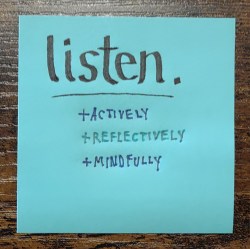
Listen.
“The single biggest problem in communication is the illusion that it has taken place” – George Bernard Shaw
My wife was in the process of telling me all about her day, in some detail, and if you’d asked me, I would have told you that I was listening to her.
But was I?
At one point she accused, “You don’t even know what I just said!” And I immediately replied that of course I do, and then proceeded to… well, show my ignorance.
We had a good laugh about it, since after we had established that I had forgotten what she said, she forgot what she had been talking about in the first place (bullet dodged). But it reminded me that I want to do a better job of listening, at home with my wife and son, and at work with my colleagues.
So what makes a good listener?
I believe it helps to be mentally and emotionally present for the conversation in the first place. But with presence established, what can we do to improve our listening skills?
I’m sure we’ve all heard reminders to use active listening for the best communication, and I think we think we know what that means, but just in case, let’s explore a bit. I know I needed to. 🙂
How to use active listening
My good friend Google turned up a seemingly obscure document that I think sums the practice up nicely, in the form of a teaching note from JoAnne Yeates for the MIT Sloan Communication Program.
From the note, an active listener:
- Looks and sounds interested in the speaker. Maintain good eye contact (but not too intense!). Try raising your eyebrows ever so slightly to indicate curiosity. Maintain a body position that shows attentiveness. If standing, ensure that your feet are pointed toward the speaker, not away from them. Use vocalizations like “mm-hmmm”, “uh huh”, “yes”, or “got it” to encourage them to continue.
- Adopts the speaker’s point of view. Try to see things from their perspective. Try to suppress any initial reactions and to hear and understand as if you were in their position.
- Clarifies the speaker’s thoughts and feelings. Limit your own talking to things that will encourage the most information and emotional content from the speaker, such as requests for additional information. Ask open-ended questions like “And how did you feel about that?”, or “Does that work for you?”. Check the accuracy of your understanding by asking questions that convey it, such as “So, you’re frustrated about that.”
Actively listening when communicating improves the chances that someone’s whole message can really get through. And wouldn’t you want them to do the same for you?
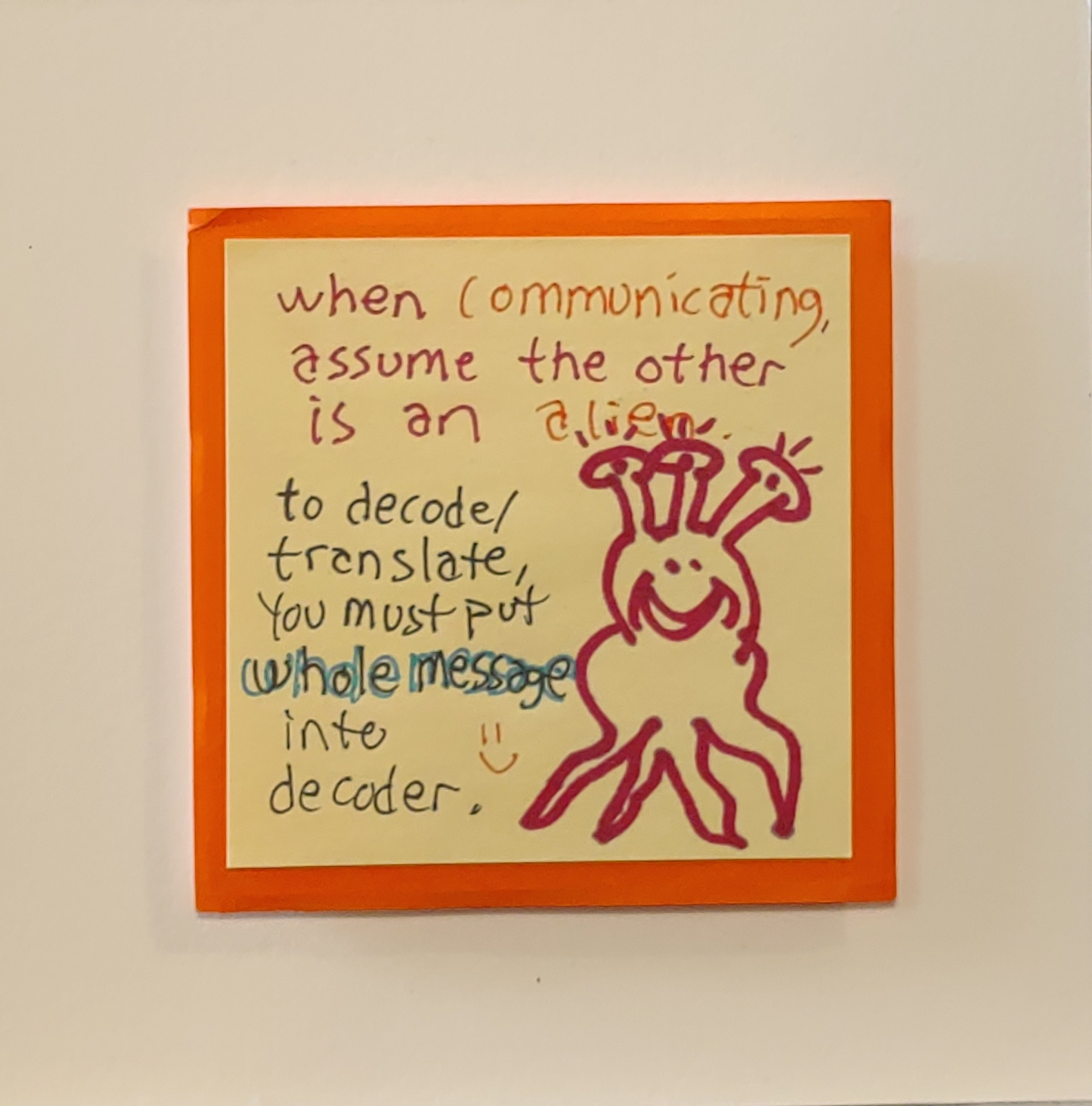
When communicating, assume the other is an alien… to decode/translate, you must put whole message into decoder. 🙂
Reflective listening
You might have heard the term reflective listening. I tend to want to conflate the two, and active listening is already applying aspects of this technique.
But reflective listening both enhances active listening and goes deeper to elicit as full a sense as possible of the speaker’s thoughts and feelings. It involves reflecting back to the speaker what you think they said in order to confirm (or correct) your understanding and encourage them to continue elaborating.
“Reflective listening is hearing and understanding, and then letting the other know that he or she is being heard and understood.”
There are five categories of skills related to reflective listening:
- Acknowledgements – “Uh-huh”, “mm-hmmm” and the like to show you are following the conversation.
- Reflecting content – the facts of the conversation.
- Reflecting feelings – how the facts make the person feel.
- Reflecting meaning – the essence of both the content and the associated feelings.
- Summarizing – repeating back what was said in different words to reflect the main points.
The reflecting process involves four steps:
- Taking in cues – While someone else is speaking, you are taking in cues from the areas of content (the words they are saying), feelings (stated or implied), and context (things you know or are aware of, other information you may know from the past).
- Sorting – sifting through the cues to arrive at the essence of what is being communicated.
- Drawing a conclusion – determining that essence and formulating a sentence to yourself about what the person is trying to say.
- Expressing the essence – sharing that conclusion back to check understanding.
Note that when sharing back it’s important not to simply parrot back what the other person said – they were there, they heard it… they said it. 🙂
It’s also important not to think of what you’re going to say next while attempting to focus on what the other person is saying and feeling.
Reflective listening is very different than providing what Neil Katz and Kevin McNulty call high risk responses (statements which are “likely to take the focus off the other and generate negative feelings”) in their paper on the subject.
These responses tell others that “they aren’t capable of doing for themselves, that there is something wrong with them, or that what they are saying is uncomfortable for you to hear.”
Some high risk responses to avoid:
- “I completely agree with you” or “I disagree on that point” – these introduce your own evaluations or judgments into the process and shift the focus to yourself.
- “What I think you should do is…” or “Why not take a different approach?” – these responses indicate your attempts to solve the problem for them, which is not necessarily what they are looking for.
- “Things will get better” or “I understand” – these attempt to divert the person from their problem, or prove that you’re listening without really doing so, respectively. They’re forms of withdrawing from the conversation.
Mindful listening
Mindful listening is a way of listening without judgment, criticism or interruption, while being aware of internal thoughts and reactions that may get in the way of people communicating with you effectively.
Mindfulness can be simply described as bringing attention to the present moment and experiencing it directly, using an open, accepting, and non-judgmental awareness.
Mindful listening is the practice of “bringing this full, moment-to-moment awareness to a speaker and their message.”
If you meditate, or use a meditation or relaxation app, you should be able to find meditations focused on the senses, and particularly on your sense of hearing.
Typically they’ll begin by getting you comfortable and relaxed, focusing on slow deep breaths and the feeling of those breaths as they enter and leave the body. Then, with eyes closed or partially closed, start to notice the sounds around you.
- Notice that you have a sense of directionality of sounds even with your sight removed from the equation.
- Notice qualities about the sounds… are they high or low-pitched? Are they pleasant or annoying?
- Now try to notice sounds without judging them. Just mentally label them (bird. refrigerator. car.).
- Notice what you can hear when you actually pay attention, rather than letting the sounds fade into the background as they often do when our brain isn’t paying attention to them.
True mindful listening, though, is a specific practice:
“Mindfulness encourages you to be aware of the present moment, and to let go of distractions and your physical and emotional reactions to what people say to you.
When you’re not mindful, you can be distracted by your own thoughts and worries, and fail to see and hear what other people are doing and saying.”
Author Charlie Scott, in his study, “Get Out of Your Own Head: Mindful Listening for Project Managers,” describes three key elements of mindful listening that we can use to improve our listening skills:
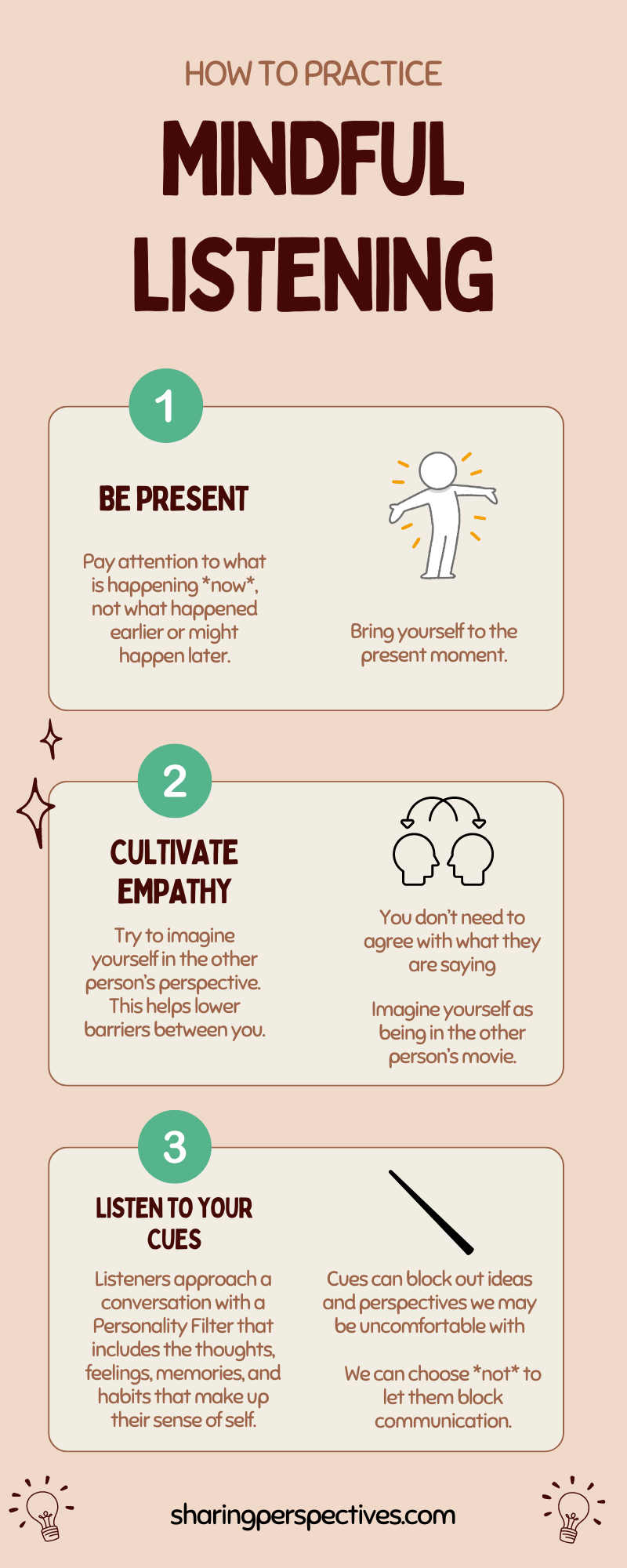
- To listen mindfully, first be present (this will be a theme, here).
- Pay attention to what is happening now, not what happened earlier or what might happen later. Bring yourself to the present moment.
- Next, try to cultivate empathy.
- Since we often see the world through our own experiences, putting yourself in someone else’s perspective, as with active listening, helps lower any barriers between you.
- This doesn’t mean that you need to agree with what the person is saying – just that they are speaking their own truth.
- It might help to envision yourself as a walk-on actor in the other person’s movie.
- Finally, listen to your own “cues”.
- Listeners approach a conversation with a Personality Filter that includes the thoughts, feelings, memories, and habits that make up their sense of self.
- Cues are what Scott describes as “the thoughts, feelings and physical reactions that we have when we feel anxious or angry, and they can block out ideas and perspectives that we’re uncomfortable with.
- Mindful listening can help us to be more aware of our cues, and allow us to choose not to let them block communication.
Mindful listening amounts to simply listening carefully and attentively – without judgment, without focusing only on what you’re going to say next, without coloring what you’re hearing based on your biases.
If you think that sounds a lot like active listening, you aren’t alone. 🙂
Final thoughts
Here’s our card:
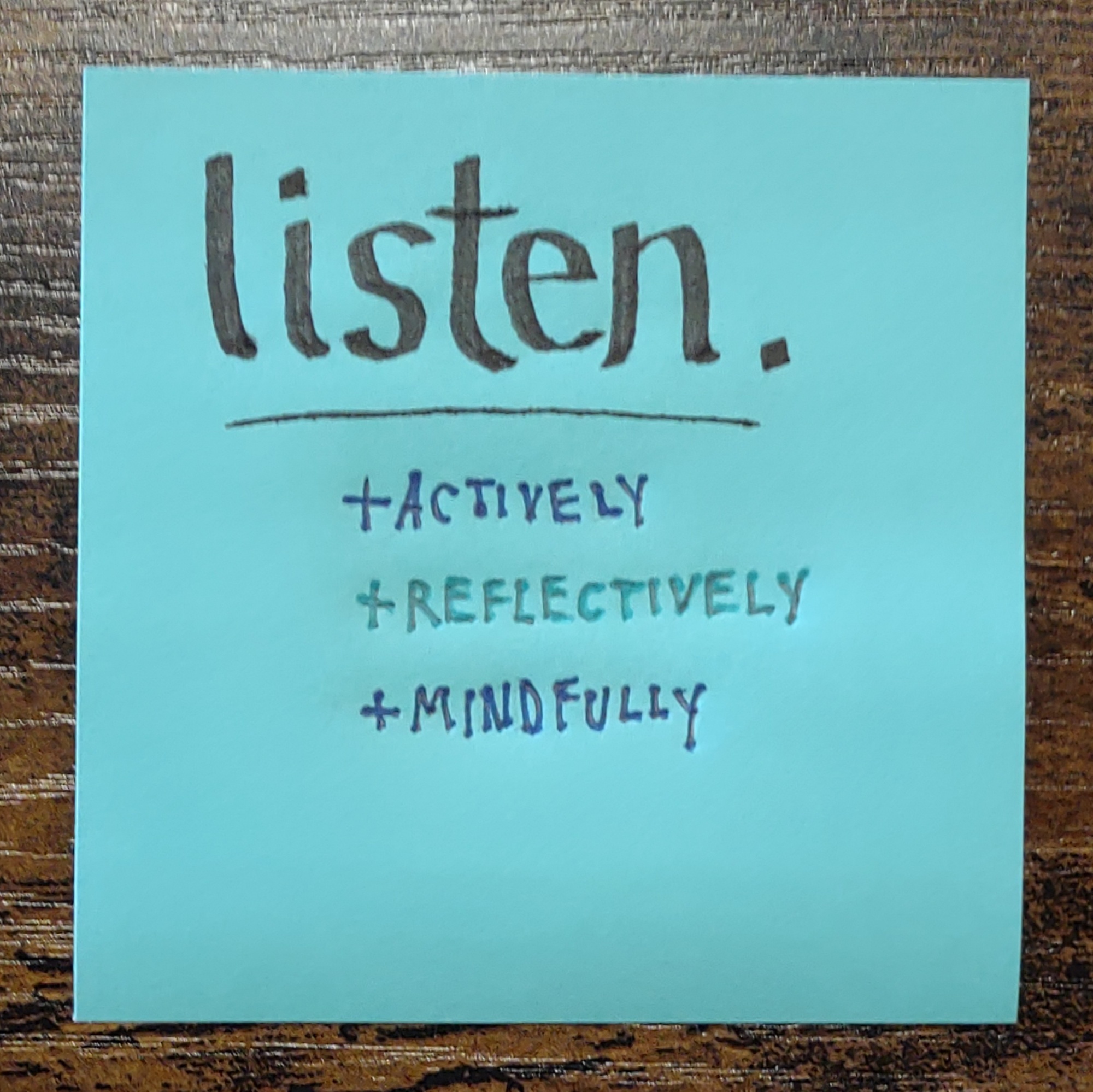
I feel that we owe it to the others in our lives to do our best to truly listen when they are trying to communicate with us.
When we listen to someone else, actively, reflectively, or mindfully, we are validating their perspective, regardless of our thoughts on the topic. And often it takes a little bit of effort on our part to get at what someone is really trying to communicate. But I think you’ll find that it will always be worth the effort.
I do know that the next time my wife asks me what she just said, I hope I’ll do a much better job of showing my attention and understanding her message, because I’ll do my very best to truly listen to what she is saying.
And if I screw it up again, I’ll just need to keep practicing. 🙂
But at least I hope she’ll know I’ve been trying.
Our attention is our most precious gift, and it costs us nothing… why not give generously?
Do you have any tips or tricks for listening better? Please share them in the comments below, or send us an email from the About page!

Discover more from sharing perspectives
Subscribe to get the latest posts sent to your email.
 sharing perspectives
Trackbacks & Pingbacks