
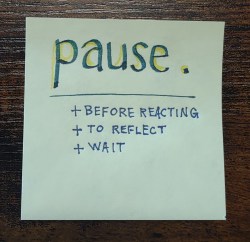
Pause.
“He who can no longer pause to wonder and stand rapt in awe, is as good as dead; his eyes are closed.” – Albert Einstein
“Through the sacred art of pausing, we develop the capacity to stop hiding, to stop running away from our experience. We begin to trust in our natural intelligence, in our naturally wise heart, in our capacity to open to whatever arises.” – Tara Brach

When I started this blog, a little over 10 years ago, I was seeking enlightenment. Among other things.
I practiced meditation and yoga. I took karate lessons. I sought out a local Buddhist monastery and explored the work of Tara Brach, Rick Hanson, Thich Nhat Hanh, and other mindfulness advocates and teachers.
Meditation never took as a daily practice for me, but I did learn some key principles that I try to apply in my daily life. One of these principles is the concept of the sacred pause.
Whenever I sense that I’m at some sort of crossroads, when the choices I make will echo into eternity (well, maybe not eternity, but at least for some time), or when I sense myself responding in a way that is not in harmony with my life goals – whether I’m in a meeting at work, working on a project, talking with my wife or my son, collaborating with colleagues, or anything else – I try my best to insert a pause to pay attention and check my intentions.
One area that provides opportunities to practice consistently are my occasional disagreements with my lovely wife. My wife insists that she is unable to pause most of the times she might want to, because… well, hormones. And she has a point – sometimes our emotions or our bodies take us away.
But that doesn’t mean it isn’t important to try to come back. 🙂 So I do my best to pause for us.

What does it mean to pause?
For me, it means to stop, even if just for an instant, to pay attention to my intentions. To take a moment to ground myself in the present moment to focus and reflect, even if only for the tiniest of moments, on my intentions, both in that moment and in the long term.
I know, that’s a lot to pack into a moment, but if you can learn how to do it, it’s a powerful practice. And a really neat trick. 🙂
Why are attention and intention important?
Deepak Chopra describes it this way:
“Attention is focused awareness. Intention is awareness given a purpose.”
In order to open the opportunity for a pause, we first need to be paying attention to what is happening now. Only then can we evaluate the harmoniousness of our next action to further our intentions.
To remind us of our intentions and what is most important, we need to engage our higher thought processes. System 1 is not up to the task… we need to engage System 2.
If you haven’t read “Slow your thinking“, here’s a quick summary of Daniel Kahneman’s System 1 and System 2 from The Decision Lab:
“System 1 thinking is a near-instantaneous process; it happens automatically, intuitively, and with little effort. It’s driven by instinct and our experiences. System 2 thinking is slower and requires more effort. It is conscious and logical.”
And of course to get better at this skill, as with any skill, we need to practice.
So let’s break it down.
To learn to pause, we need to:
- Learn how to come back and be present
- Slow our thinking
- … and practice.
It isn’t always convenient to insert a long pause to gather your thoughts, especially in emergent situations. But the longer you practice pausing, the less time it will take. And in those times without the luxury of time we can start with a tiny, little, unassuming, and non-threatening micro-pause. And then build from there.
Ready to learn how? Let’s go!
Why and how to pause
Dorsey Standish with Mastermind Meditate advocates for using the S.T.O.P. technique – Stop what you’re doing, Take 3 deep breaths, Observe what’s happening (thoughts, feelings, sensations), and Proceed in a way that supports you. This practice can be used during times of stress or transition from one activity to another to pay attention to your intentions.
Dorsey introduces the technique in a short meditation in the three-minute video below.
With practice, this one- to two-minute meditation can be done in as little as 10-20 seconds:
- Stop and come to a place of rest.
- Take some deep breaths, in through the nose, out through the mouth.
- Observe what’s happening within you – are there any emotions present? Or strong bodily sensations that you notice?
- Proceed in a way that will support you.
But to practice pausing, all you really need is five magical seconds
Kori from Kori At Home has this to say about finding peace in a five second pause, particularly in the context of parenting:
“But those five seconds are powerful and magical when it comes to our children. “
From Kori’s article, here’s the “simple magic” of the five second pause in parenting:
- We don’t need to have all the answers right away
- We don’t need to have perfect answers
- We don’t jump to conclusions
- We don’t answer the question we think our children are asking because we are actively listening to them
- We only answer the question they are asking
- We give our children the opportunity to gather their thoughts and verbalize
The five second pause in other contexts
- Wayne Turmel advocates at Management Issues for a five second pause during meetings, presentations, and training sessions because:
“If you can count to five slowly, you can probably get better results from your online presentations, meetings and training sessions.
The reason, strangely, is that we often don’t give people enough time to respond when we ask for their input, questions or comments.”
When the pause stretches to 3 or 4 seconds, there will have been enough time for it to sink in that you actually expect a response, and discomfort with the lack of a response becomes stronger. In the final second your audience members will be able to formulate a response, and if there is one to be had, someone will provide it around the end of the five seconds.
Once again, a lot can happen in that short period of time.
- Tanya Leigh at the School of Self-Image talks about the practical applications of a sacred pause in everyday life:
“And there’s that moment where you can engage in the familiar pattern of overwhelm, or you can take that sacred pause, take that five seconds to take a deep breath and say, wait, it can be different. It doesn’t have to be this way.
I can let the kids be crazy in the back seat, I can still have dinner that needs to be cooked, I still can have laundry that needs to be done, I can still have the job that I need to go to tomorrow, and yet I can respond to all of it so differently.
And those choices happen in the spaces of five seconds or less. And those choices are shaping your entire life.”
Five seconds is long enough to engage System 2 and your higher self.
Final thoughts
Learning to pause is a powerful way to ensure that “current” you does not accidentally foil “future” you’s plans and goals, and helps to focus your actions in the current moment on serving your true intentions.
The key takeaway if you don’t have time to invest in the moment? Even just 5 seconds?
When in confrontations, when feeling overwhelmed, when emotions run high, just stop – take a slow breath (in and out), think (engage System 2!), and then respond.

We can choose to pause:
- Before (re)acting
- To reflect
- To WAIT*
*WAIT = “Why Am I Talking?”
This comes from my friend and colleague Marissa Ryan, who learned it from the late, and great, Lloyd Jordan, her favorite mentor.
The idea is that before taking up the air in the room or in a meeting, we might pause to ask “Why am I talking?”, really listen to what’s going on, and consider what value we can truly provide to the conversation. If value, as perceived by the others in the group, is present, then by all means continue and contribute! But maybe pause for a moment, just to be sure.
One last way to think of this kind of pause… every time I go out the back door of my house to get to my office, I need to stop and think what state the alarm is in so that I don’t thoughtlessly trigger it. After setting off the alarm several times, I’ve trained myself to pause and think, usually with my hand on the knob, before taking the action of opening the door – what state is the alarm in? What time is it (because it’s programmed to turn on and off automatically)?
Then, and only then, do I turn the knob and open the door.
What do you do when you need to pause? What situations do you find challenging to insert a pause into?
Discover more from sharing perspectives
Subscribe to get the latest posts sent to your email.
 sharing perspectives