
Mistakes are opportunities!
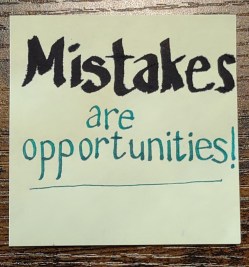
Own them. Befriend them. Learn from them.
“Mistakes are the proof that we are human and flawed, but also capable of growth and improvement.” – Brené Brown
“Your mistakes do not define you; they educate, empower, and enable you to reach your true potential.” – John C. Maxwell, Failing Forward (2000)
I made a mistake today.
I zigged when I should have zagged, and things ended up differently than they might have, and I was left to confront the ramifications of my choices.
See, I wanted to write “poor choices” there, but that casual addition has the weight of negative judgment applied to it. I’m trying to practice viewing my mistakes from a perspective of curiosity, but the negative connotations associated with the word “mistake” are deep and broad and, especially in times of stress, present in my thoughts and emotions when I make them.
Does that sound familiar, at all?
When I think back on my mistakes – and I’ve made a few – they come in a couple of different flavors. Some bring up a sense of shame and failure, while others remind me of something I learned from the experience.
The difference doesn’t seem to be in how I view mistakes now – it seems to come from how I viewed the mistake at the time. And how I viewed the mistake at the time depended in part upon how others reacted to the results.
In Positive Discipline (and, interestingly, in Lean manufacturing and management), mistakes (or the resulting problems) are viewed not as something to be avoided but as opportunities to learn. Framing them this way takes the sting out of them, which makes them easier to own, and easier to bring a curiosity to about what might be learned from the experience.
Mistakes are something to be celebrated, because with them come opportunities.
Mistakes in Positive Discipline
In Positive Discipline, we learn to “See mistakes as opportunities for learning.” But “mistakes” come with baggage.
From Jane Nelson in the above article:
“When parents and teachers give children negative messages about mistakes, they usually mean well. They are trying to motivate children to do better for their own good.
They haven’t taken time to think about the long-term results of their methods and how the decisions children make stay with them for the rest of their lives.”
Take a moment to think back about how if felt when you made a mistake as a child – breaking a favorite vase, forgetting to come home on time, neglecting to study for a big test – and what the word means for you now.
“Close your eyes and remember the messages you received from parents and teachers about mistakes when you were a child.
When you made a mistake, did you receive the message that you were stupid, inadequate, bad, a disappointment, a klutz?
When hearing these messages, what did you decide about yourself and about what to do in the future?”
It’s important to remember that “Children can truly learn the courage to be imperfect when they can laugh and learn from mistakes.”
Cast mistakes in a positive light – “Congratulations! You made a mistake! What did you learn from it?” – and begin to take away some of the stigma that’s associated with them.
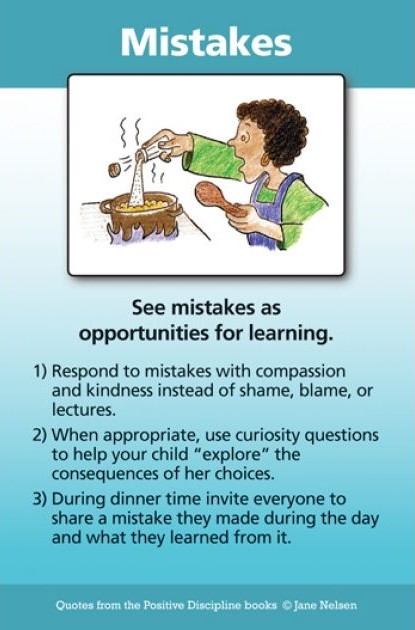
Positive Discipline teaches the 4 R’s of Recovery from Mistakes:
- Recognize that you made a mistake. Feel the embarrassment, and let it go.
- Take Responsibility for your mistake. Without blame or shame.
- Reconcile by apologizing if others are involved.
- Resolve to focus on finding solutions. Together.
We can take a moment to connect with our children, then walk through these steps with them to help them recognize their mistake and the attendant opportunity.
Mistakes in Lean
Mistakes in the Lean manufacturing and Lean management contexts are “problems“. The word conjures up similar negative associations for many of us, and just as similarly needs to be de-stigmatized.
In our training deck for our Lean 8-Step Problem Solving process in the IT Department at the City of Seattle we open with a discussion of the benefits of continuous improvement as a problem solving approach. The general idea is that many incremental changes add up to huge improvements in processes, and the mindset is one of continuously striving for perfection.
But a shift in mindset is needed in order to make the most of the opportunities presented by problems or mistakes.
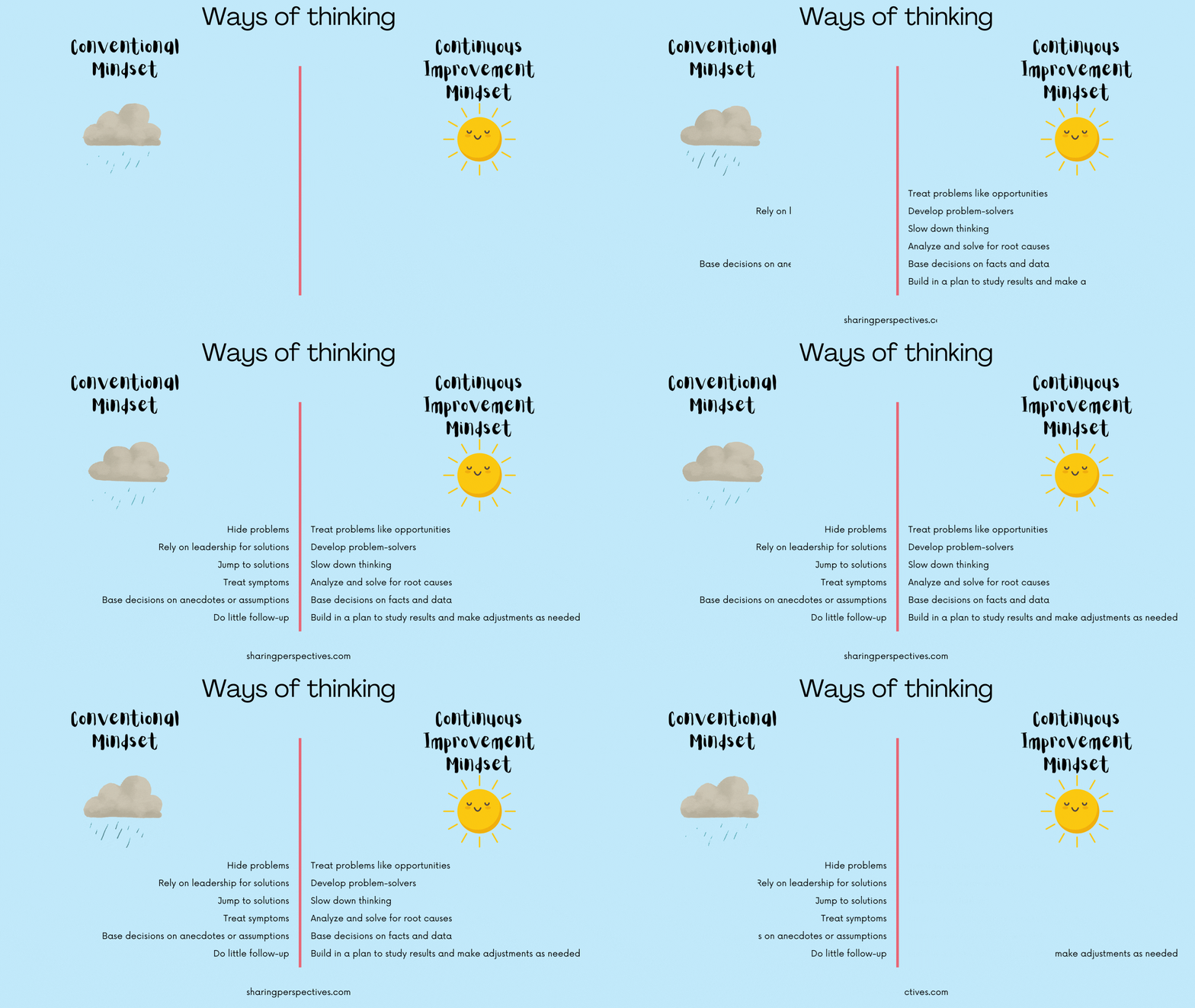
For example, in a conventional workplace, we tend to:
- Hide problems
- Rely on leadership for solutions
- Jump to solutions
- Treat symptoms
- Base decisions on anecdotes or assumptions
- Do little follow-up
But in a Continuous Improvement workplace, we learn to:
- Treat problems like opportunities
- Develop problem-solvers
- Slow down thinking
- Analyze root causes
- Base decisions on facts and data
- Build in a plan to study results and make adjustments as needed
Can you see the ways in which a Continuous Improvement workplace sounds a lot like a Positive Discipline family?
We then challenge our trainees to think of a problem as the difference, or “gap“, between what should be happening and what is actually happening.
When we can make this shift in our perspectives, problems become opportunities to close the gap and deliver better products to our customers. Or better relationships with the important people in our lives. 🙂
It’s a major shift from seeing a problem or a mistake as a failure to seeing it as an opportunity. But if we can manage it, and teach it to our kids, so many wonderful things can happen.
Mistakes in innovation
Mistakes are often a key component of innovation. Thomas Edison famously made many mistakes on the path to some of his greatest inventions.
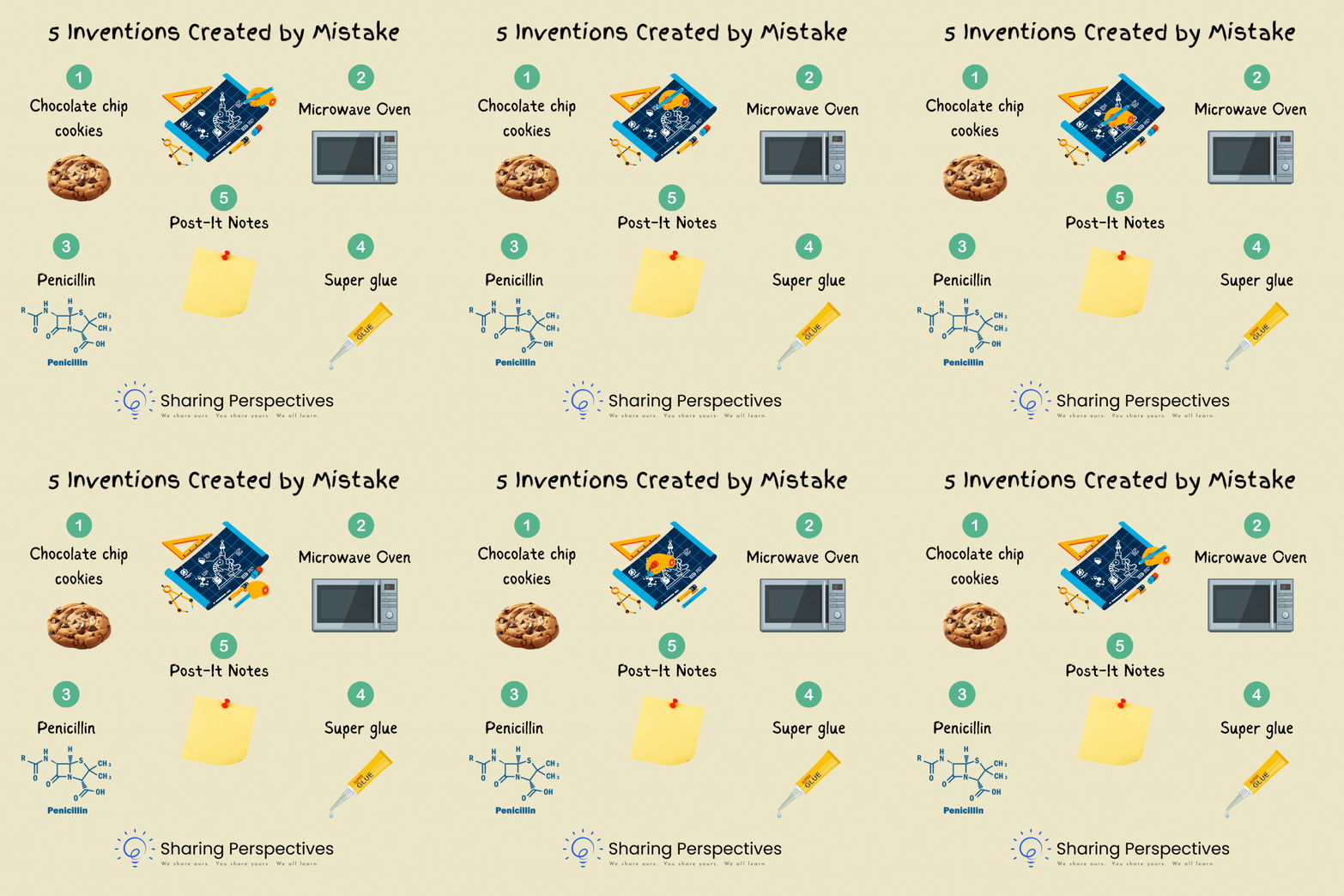
Here are the results of some of the most fortuitous mistakes in innovation:
- Chocolate chip cookies – Ruth Graves Wakefield, co-owner of the Toll House Inn, was hoping the chopped up chocolate chunks she added to her cookies would melt evenly throughout the cookie. Instead, she got chocolate chips!
- Microwave oven – If it wasn’t for a candy bar melting in Percy Spencer’s pocket in 1945, the microwave oven may have never been invented!
- Penicillin – Scientist Alexander Fleming left his lab a mess because he was in a rush to go on vacation.
- Super glue – During World War II, Harry Coover, a chemist for Eastman Kodak, was trying to create a suitable plastic for gun sights…. but he failed!
- Post-It notes! – Spencer Silver, a chemist for 3M, failed in his attempts to make heavy-duty adhesive for the aerospace industry. The best he could do was a lightweight but reusable temporary adhesive.
That’s right… without a mistake, Post-It notes, and therefore most likely this blog, wouldn’t exist.
Final thoughts
Here’s our card:

We make mistakes:
- To learn
- To know
- To own
- To grow
I find that if I try to ask curiosity questions about a mistake immediately after I make it, I’m much more likely to view the mistake in a positive light than in a negative one. And I’m even more likely to learn something from the experience.
And even better – I’m more likely to act to take advantage of the opportunities it offers.

I encourage you to make and own as many mistakes as you can, and to encourage your children and your colleagues to do the same. 🙂
What’s the biggest mistake you are glad to have made? Share with us in the comments!

Discover more from sharing perspectives
Subscribe to get the latest posts sent to your email.
 sharing perspectives