
Be curious.

“In the beginner’s mind there are many possibilities, but in the expert’s there are few.” – Shunryu Suzuki (Zen Mind, Beginner’s Mind)

My wife’s birthday, which she shares with a close friend, is coming up, and she mentioned a specific cake, made by a bakery in Austin, Texas (we live in Seattle, Washington). She opined that it would be lovely to have such a cake to celebrate the pair of birthdays, and wondered if they might ship such a thing out of state.
Now, in my uninformed opinion, it seems impractical to expect to be able to ship cross-country something as delicate as a birthday cake. And despite a lack of direct knowledge in these matters, I felt reasonably confident in expressing that opinion.
Surprisingly, this was called out as unsupportive.
Looking back now, I wonder if instead of passing judgment on my wife’s pondering, I might have instead developed a sense of curiosity about how she might imagine such a thing could be feasible. Or better yet, resolved to answer the question definitively by searching for the bakery’s contact information.
It’s a question I’ll try to ask myself more often, in my never-ending quest to basically be less of an ass.
But more than that, I want to encourage adoption of a kind of curiosity-based approach to life in general that includes and expands on teachings from different domains.
Mindful curiosity
In Zen Buddhism, the term “beginner’s mind” refers to a mindset that is free from preconceived notions and judgments. Rather, it represents a state of pure curiosity and receptivity.
You can also think of beginner’s mind as “don’t know” mind.
When we’re new to something, we don’t know anything, and anything is possible. As an expert we gain knowledge and proficiency, but as more is known the doors start to close on possibilities.
When we’re beginners we don’t even know what we don’t know, and adopting this mindset even at times we think we know something can create a wealth of opportunities to learn and grow further.
That isn’t meant to imply that expertise is bad… just that sometimes, when you suspend that expertise for a moment, you might open yourself to a novel approach to a problem.
Imagine the approach that a small child takes to pretty much everything in their environment when given free reign to explore. Imagine approaching everything and everyone with that same state of expectant curiosity and wonder.

It’s a mindset that mindfulness practitioners the world over seek to adopt. The concept itself is simple enough. But life can be complicated, so its practice can be challenging.
The practice of the half-smile
The practice of the half-smile, from Yvonne Rand, a Soto Zen Buddhist priest and meditation teacher, can help cultivate beginner’s mind:
“The practice of the half-smile has nothing to do with feeling like smiling. For those of you who have not done this practice before, you can think of it as “mouth yoga.”
– Yvonne Rand
Just lift the corners of your mouth slightly—not a full smile or a grin—for the space of three full breaths.
Let your attention be on the sensation of slightly lifted corners of the mouth and then with the three breaths.”
Don’t rush the breaths… experience them fully. Don’t change the breath… observe it as it is.
For those with a meditation practice, the half-smile is an easy way to return to what you might think of as your “Buddha space”. 🙂
You can practice it as the first thing when you wake up in the morning, while standing in line, every time you get into or out of your car, any time when you have, or want to create, a moment to open yourself to the possibilities that life will present you with.
Curiosity questions
In Positive Discipline we learn to ask younger children questions instead of telling them what to do. These are known as curiosity questions.
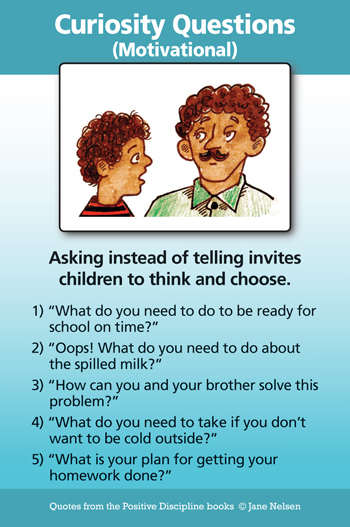
The questions above are alternatives to statements or commands like: “Come on, it’s time to go, we’re late!” Or, “I’ve told you five times to do your homework! If you don’t get it done you can’t go to your friend’s house.”
The idea is that by being curious instead of judgmental, we allow space for information we didn’t previously have available, and we allow the child to determine how they will achieve a goal, which gives them agency. It also helps children explore the consequences of their choices, rather than imposing consequences upon them. They feel respectfully included instead of blamed or shamed.
From Jane Nelson in a Positive Discipline blog post about curiosity questions:
“When children hear a command, a signal is sent to the brain that invites resistance. When children hear a respectful question, a signal is sent to the brain to search for an answer. In the process they feel capable and are more likely to cooperate.”
Think for a moment about how you feel when you’re given a command. I myself have some kind of instinctive internal rejection of authority that kicks in when someone tries to issue me a command. I don’t like it. And I’m more than likely to want to do the opposite.
And to kick your game up a notch, you can practice using conversational curiosity questions specifically:
“Conversational curiosity questions take more time than motivational curiosity questions because you are doing more than inviting the child to think of a solution to a simple task that requires attention, such as, “What do you need to do to get your work done on time?” Conversational curiosity questions require just what the name suggests: a conversation.”
Asking questions with genuine curiosity can change almost any atmosphere from negative to positive.
And pretty much any problem can be turned into a question. If you want to let children know they’re being too noisy, you might ask something like “Who thinks it’s too loud in here? Who thinks it’s too quiet?” for example.
When faced with a parenting challenge, even a difficult one, we can layer curiosity questions in a measured approach to resolving it.
- “What happened?”
- “How do you feel about it?”
- “How do you think others feel?”
- “What ideas do you have to solve this problem?”
Notice that the first question is fact-based, the second and third are “heart” based, and the last is “head” based. This allows for feelings and emotions to be acknowledged and understood before attempting to solve a problem.
And again in Jane’s words:
“The end result is focusing on solutions to the problem instead of focusing on consequences.”
This practice teaches children so much at once. They have an opportunity to develop their language for emotions, they learn empathy, they learn problem-solving skills, and when it all comes together it’s a beautiful thing.
But the benefit of using curiosity questions goes far beyond the domain of parenting. For example, I’ve found that using curiosity questions with my team at work is a thousand times more effective than issuing directions or orders (micromanagers of the world, please heed). And when I’m in a dispute with a service provider I ask curiosity questions to help me better understand their perspective.
In fact, if you replace the words “child” and “children” above with “spouse”, “colleague”, etc., you might find that curiosity questions are a wonderful practice to use with people in general.
Final thoughts
Here’s our card:

To teach ourselves to be curious rather than judgmental, we can practice adopting beginner’s mind and learn the language of curiosity questions.
But I’d like to close with a call to action to try to be more curious in general. Learning is a lifelong occupation, and if you direct that learning where your curiosity goes, you’ll be all the more excited about what you learn, and all the more able to put it into action. So be curious, and then free that curiosity to wander the world and come back with whatever it leads you to.
Do you have any thoughts about mindfulness or beginner’s mind? Have you tried to use curiosity questions, as a parent, or in life in general? Please share your perspective in the comments!

Discover more from sharing perspectives
Subscribe to get the latest posts sent to your email.
 sharing perspectives