
Question your beliefs.
“For some of our most important beliefs, we have no evidence at all, except that people we love and trust hold these beliefs.
Considering how little we know, the confidence we have in our beliefs is preposterous – and it is also essential.” – Daniel Kahneman
My wife and I argue all the time about actors and actresses in movies or shows that we watch. She’ll point someone out and say something like, “Oh, that’s the same guy that was in the other show we watch”, and I almost invariably react with “No it’s not”, even though she is almost as invariably correct.
But not every time. Sometimes I surprise her, and we look up the person on the interwebs and it really wasn’t the person she thought it was.
And either way, it doesn’t stop either of us from believing that we are right in every fiber of our beings the next time we’re watching a movie.
Are you certain you’re right? Are you firm in your beliefs?
You have the most reason to question them.
It isn’t possible that everything we believe is true. We often think we have all the facts we need to make up our mind, but do we? How did we come by those facts? How did we come by the beliefs they support or reinforce?
When we think we know something, we tend to close ourselves off to new evidence that challenges that belief, and readily accept any new evidence in support of that belief.
We need, from time to time, to reflect on our beliefs and actively question them if we want to ensure they are guiding us in the direction we want to be going. Especially because so many of our beliefs are so deeply tied to our identity and our sense of self.
I’ve been thinking about beliefs and came across an article in Psychology Today that explored many of the ideas I’m interested in examining. I’d like to take this post to break it down in a little more detail.
But there’s more! I also want to get into critical thinking, what it is, and how it can be applied to challenge and in some cases change our beliefs. This comes courtesy of a Medium article by Shari Keller that you may or may not have access to.
What actually is a belief?
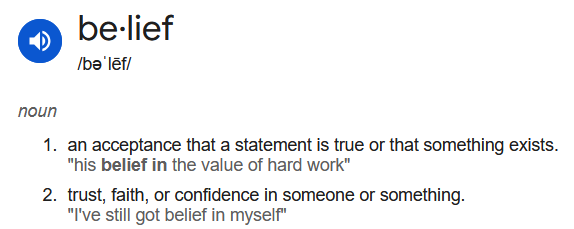
In an article for Psychology Today titled “What Actually Is a Belief? And Why Is It So Hard to Change?“, Dr. Ralph Lewis writes:
“Beliefs are our brain’s way of making sense of and navigating our complex world.
They are mental representations of the ways our brains expect things in our environment to behave, and how things should be related to each other—the patterns our brain expects the world to conform to.
Beliefs are templates for efficient learning and are often essential for survival.”
We experience the external world entirely through our senses. Our perceptions and experiences are what ultimately define our beliefs. It is exceedingly difficult to accept that those perceptions and experiences are not necessarily reliably representative of objective reality.
Experience is defined as “practical contact with and observation of facts or events”. But because our experience is subjective, we need information from other perspectives in order to see a fuller and more objective truth.
And it can be hard to recognize this fact – we give so much more weight to what we “see with our own eyes” than we do to the very same subjective experiences of others. But what makes a single point of reference more valuable than multiple points, really?
Because it is uniquely your own.
And because it is uniquely your own you will defend it against all comers. And rightfully so – your perspective is hard won.
“We will more readily explain away evidence that contradicts our cherished belief by expanding and elaborating that belief with additional layers of distorted explanation, rather than abandoning it or fundamentally restructuring it.”
Homeostasis and System 1
Let’s look to Brittanica for a definition of homeostasis:
Homeostasis is any self-regulating process by which an organism tends to maintain stability while adjusting to conditions that are best for its survival. If homeostasis is successful, life continues; if it’s unsuccessful, it results in a disaster or death of the organism.
Homeostasis – a mechanism for early and fundamental life, seems to apply to higher functions as well. So imagine beliefs that we incorporate as part of our core selves, and the tendency to maintain those beliefs and therefore one’s sense of self in favor of the energy expenditure required to question them.
Here I’ll take a moment to touch on Daniel Kahneman’s model of behavior described in his book, “Thinking, Fast and Slow”.
Kahneman posits envisioning our minds as operating as a pair of distinct systems.
System 1 is fast. Very fast. And instinctive. That often has its advantages.
System 2 is slow. It costs more energy, but delivers deeper, more logical results.
System 1 is kind of the default pilot as we go about our day, and whenever we put our thinking caps on, we can access System 2.
System 1 represents a kind of mental homeostasis, where the goal is to keep things in balance and respond quickly and effortlessly to the majority of what life throws at us, ensuring that the system can tolerate minor variation.
System 1 applies our beliefs constantly throughout the day, often with out a single peep out of System 2. If we want to question our beliefs, we need System 2 to do it.
Science vs. faith
So far I’ve talked a lot about science, but not at all about faith. Let’s begin this section with a couple of definitions.
Faith is defined as “complete trust or confidence in someone or something” according to Oxford, while science can be defined as “the systematic study of the structure and behavior of the physical and natural world through observation, experimentation, and the testing of theories against the evidence obtained.”
Another way to compare and contrast the two is simply:
“Faith is based on belief without evidence, whereas science is based on evidence without belief.”
Dr. Ralph Lewis, in Psychology Today, tells us more:
“Science values the changing of minds through disproving previously held beliefs and challenging received authority with new evidence. Faith is far more natural and intuitive to the human brain than is science. Science requires training. It is a disciplined method that tries to systematically overcome or bypass our intuitions and cognitive biases and follow the evidence regardless of our prior beliefs, expectations, preferences or personal investment.”
This makes science sound hard. And it is, of course. If it wasn’t, everyone would be doing it. All the time. At least, that’s my belief. 🙂
All of this suggests that beliefs are highly resistant to change, and while that is often for good reason, in many cases, when we examine them, they really aren’t based on anything we would consider to be solid evidence if it belonged to someone else.
How can we safely question our beliefs?
So it’s hard to question our beliefs, but I think it’s necessary. How can we do this without threatening our very identities?
The first takeaway is to recognize. Understand the experiences and biases that make up your System 1 belief structure. This provides an opportunity to bypass your biases when forming and considering beliefs.
Second is that potentially self-concept-altering challenges to beliefs are effortful and exhausting. In order to be open to questioning our beliefs, all else must feel stable. And we need to slow our thinking in order to accommodate the effort that our System 2 will require.
Encountering a belief, ask yourself from time to time, “Is it really true?” Genuinely question things you believe, and be truly open to new evidence that might change the way you think about something.
If it’s a big belief, it’s a lot to question all at once, so allow a more comfortable conversation with yourself by opening to something smaller. For example, if the death penalty is an issue where you have strongly held beliefs, test them by starting with something like whether a particular execution method is more or less humane than another.
And our beliefs don’t need to change all at once… it can start with an opening to a possibility, and then using critical thinking skills to develop your own questions to form your own arguments for or against a belief, and draw your conclusions from there.
Critical thinking
Critical thinking is the ability to analyze, evaluate, and interpret information to make a judgment or decision. It helps us make sure that we have good reasons to support our beliefs.
Critical thinking teaches what is and what is not a good argument supporting a belief. It teaches what is a good reason for believing something – one that provides a high probability that something is true – and what is a bad reason for believing something.
For a fuller picture, watch the 10-minute video above.
But here are some characteristics of critical thinking:
Questioning: Critical thinkers question what they read, hear, say, or write. They also acknowledge and test assumptions they’ve previously held.
Making connections: Critical thinkers connect logical ideas to see the bigger picture.
Making informed decisions: Critical thinkers make decisions based on reliable information.
Being objective: Critical thinkers identify and solve problems in an objective and systematic way.
Communicating ideas: Critical thinkers can advocate their ideas and opinions in a logical way.
Especially in an emotional moment, this kind of introspection isn’t necessarily easy – emotion is fast and logic is slow. So of course it’s challenging to apply critical thinking in the moment.
But you can always reflect on the moment afterward. In fact, reflective thinking is another term for critical thinking.
From the Medium article linked above, as a parent you can even help to teach your child critical thinking by:
- using open-ended questions
- encouraging innate curiosity
- using project based learning and experiential learning
- using discussions and debates that encourage them to see things from a different point of view.
From Shari Keller:
“When we teach our kids to question, analyze, and understand the world around them, we’re setting them up to handle challenges — with curiosity and confidence, and with humility and deep reflection.”
Skepticism
At some point the word “skeptical” became interchangeable with “cynical”, and it developed a negative connotation.
But being skeptical is a good thing! We need to be skeptical to protect ourselves from being fooled.
The chart below was inspired by Melanie Trecek-King at Thinking Is Power in her article “How Skepticism Can Protect You From Being Fooled” – please click through and read it if you have a few minutes and would like to go a little deeper on the subject.
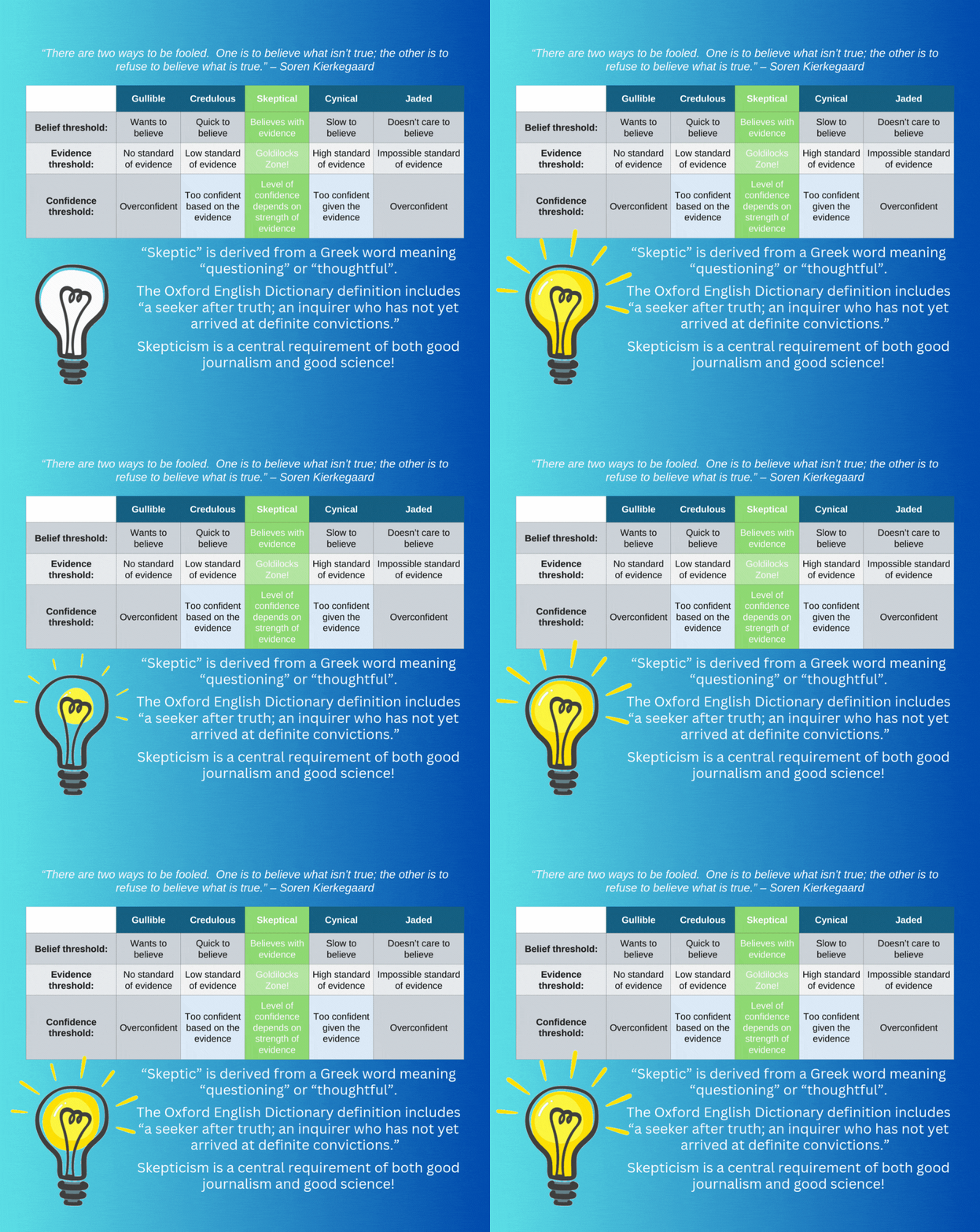
A skeptical person is happy to believe something, provided you give them reliable evidence. Their level of belief is entirely dependent on the available evidence.
Skepticism is a central requirement of both good journalism and good science.
Summary
Our beliefs are often strong, and changing them is often hard. Sometimes with good reason – imagine if you had to consciously believe that you needed to breathe and think about it constantly to avoid suffocation.
But just because something is hard doesn’t mean it isn’t worth doing, and with time, and skill, and practice, we can learn to challenge even our most closely held beliefs, and only form new ones with sufficient evidence.
Lately I try really hard to not react in immediate disagreement when my wife thinks she’s spotted someone in a movie without taking a long, hard look and a think about it.
What I’ve really learned is not to challenge her – she has a much higher probability of being right than I do when our beliefs conflict.
But when I’m confident I have enough evidence to support my claim, I’m not afraid to be right either. 🙂
Here’s our card:
How have you been able to question your beliefs?
What closely held belief will you challenge today?
Discover more from sharing perspectives
Subscribe to get the latest posts sent to your email.
 sharing perspectives