
Assume best intent.

The benefit of the doubt is free to give, and a treasure to receive.
Hanlon’s razor is a saying that reads:
“Never attribute to malice that which is adequately explained by stupidity.”
In simpler, and kinder, words:
“Some bad things happen not because of people having bad intentions, but because they did not think it through properly.”
The original quotation is attributed to Robert J. Hanlon of Scranton, Pennsylvania, US.
There are many similar sayings.
One example is “Never ascribe to malice that which is adequately explained by incompetence.” Which is perhaps a bit more forgiving.
We can be kinder still by saying “Never ascribe to malice that which is adequately explained by ignorance.” But it’s still focused on the negative, and the word “ignorance” unfortunately has many negative connotations, though it implies to me only a sense of not knowing.
Or… we could flip it around to make it a positive, and say:
“Assume best intent.”
This feels like the kindest way to capture this sentiment. In my mind it essentially means to give someone the benefit of the doubt – at least until they give you an actual reason not to.
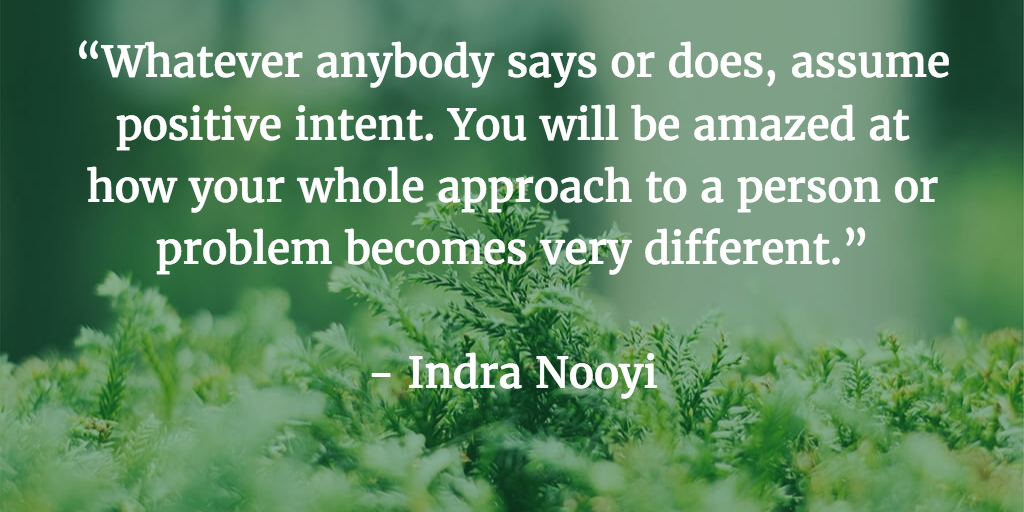
Notice that it doesn’t say “positive” intent, as in the graphic at the top. I’m on the fence about that word – it’s true that someone’s intent may not always be positive, but they may be doing the best they can at a given moment.
I was listening to my wife the other day and I was trying my best to listen fully. She made a comment that I felt was critical of me and my behavior when I paraphrased something she had said back to her, when in my mind I was doing my best to be supportive.
But applying this principle of assuming best intent, I stopped for a moment to think about what *exactly* she had said, and how she most likely intended for it to be received, regardless of what thoughts I was having at the time, and I realized that she wasn’t inside my brain and couldn’t possibly know what my own intent was, only what she felt as a result of what I said.
I realized that her intent was most likely not to criticize me, but to offer advice about how best to communicate with her in the future. And if I had given her the benefit of the doubt in the first place, I most likely would not have reacted the way I had.
A more specific example… recently my son needed to get up early so that the whole family could take a Chef’s Tour of Pike Place Market in Seattle that my wife had already bought the tickets for.
I woke him 30 minutes before the time that we needed to leave the house in order to make the scheduled tour, weighing his need for sleep with the time it takes him to get ready.
15 minutes prior to departure, I checked on him again, and he was still in bed. Starting to get frustrated, we worked out that he would get up and get ready on his own without need for additional reminders. I took him at his word, and left.
5 minutes prior to departure… still in bed. Now I was full on frustrated – was he trying to get out of the event with his grandparents? Did he not know how much the tickets were? I told him if he wasn’t able to get up and go with us he would not only owe us the money for the ticket he didn’t use, but we wouldn’t bring him back anything from the market.
Yeah, that didn’t help.
Finally, I thought to ask him why he was having so much trouble getting up to go with us. He has medically-related anxiety issues, so I asked if that was what was going on, and he said yes. And I suddenly realized in that moment that I hadn’t let him know the night before what to expect. And that he was doing the best he could under the circumstances.
Immediately I felt horrible for berating him and essentially threatening him. I apologized for doing so, told him of course we’d bring him something back, announced that he would not be joining us, and gathered up the others for the event.

Looking back, if I had only assumed best intent when he was having trouble getting out of bed to begin with – which was actually atypical lately – I could have saved everyone a lot of time and trouble.
Looking ahead, I’ll try harder to assume best intent, from basically everyone around me. 🙂

Discover more from sharing perspectives
Subscribe to get the latest posts sent to your email.
 sharing perspectives
Such great advice for all types of relationships!
LikeLike
Thank you so much! It IS for all types of relationships! 🙂
LikeLiked by 1 person